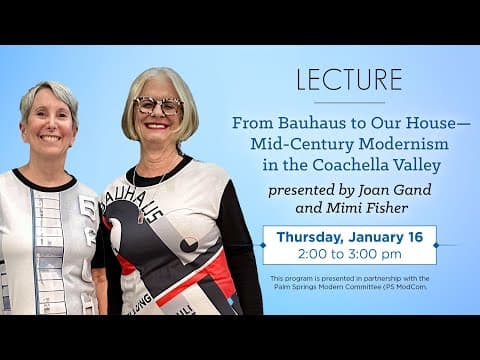
This blog post delves into the history and significance of mid-century modernism in architecture, particularly in the Coachella Valley, highlighting key architects, design philosophies, and the importance of preservation efforts.
The Coachella Valley, particularly Palm Springs, is renowned for its rich architectural heritage, especially mid-century modernism. This blog post explores the evolution of this design philosophy, its key figures, and the ongoing efforts to preserve these iconic structures.
Modernism is a design philosophy that emerged in the mid-20th century, characterized by optimism, simplicity, and a break from traditional architectural styles. It gained popularity from the mid-1940s to the mid-1970s, reflecting cultural changes and advancements in technology.
The term "mid-century modern" was popularized by author Cara Greenberg in her 1984 book about 1950s furniture. This style, often abbreviated as MCM, encompasses a broader range of design elements than modernism alone. The revival of modernism in the 1980s was influenced by Tom Wolfe's critique of the style, which sparked renewed interest among a new generation.
From 1880 to 1945, the Machine Age inspired architects to innovate with new materials like reinforced concrete and steel. This period marked a rebellion against Victorian architecture, leading to the development of modernist principles.
The first modern house in the Coachella Valley is believed to be the Popo Cabin, designed by Rudolph Schindler in 1922. Schindler's work, along with that of other architects like Richard Neutra, helped establish a modernist aesthetic in the region.
European architects like Le Corbusier and Mies van der Rohe contributed to the International Style, which emphasized sleek, functional designs. This style influenced American architecture, including the work of Albert Frey, who brought modernism to the desert.
Designed by Richard Neutra in 1946, the Kaufman House is one of the most famous modernist homes in Palm Springs. Its sleek design and integration with the landscape exemplify mid-century modernism.
Notable for its dramatic glass and concrete canopy, the Elrod House was designed by John Lautner and featured in the James Bond film "Diamonds Are Forever."
Built by the Alexander Construction Company, these homes are characterized by their butterfly roofs and open floor plans. Over 2,000 Alexander homes were constructed in Palm Springs, making them a significant part of the area's architectural landscape.
The Palm Springs Modern Committee (PSModCom) plays a crucial role in preserving mid-century modern architecture. Founded in response to the demolition of significant structures, the committee advocates for the protection and appreciation of modernist buildings.
Mid-century modernism is not just an architectural style; it represents a cultural movement that continues to influence design today. The Coachella Valley stands as a testament to this legacy, with ongoing efforts to preserve its unique architectural heritage for future generations. By understanding and appreciating these designs, we can ensure that the spirit of modernism lives on in our communities.