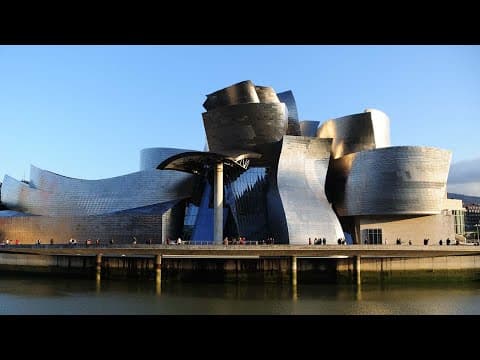
The Guggenheim Bilbao, designed by Frank Gehry, transformed a struggling city into a cultural hub and revolutionized architectural design through innovative use of technology and materials, setting a precedent for urban regeneration worldwide.
People said this building couldn’t be built. There were also those who said it shouldn’t be built. In a city devastated by industrial decline, the Guggenheim Bilbao was a gamble that could either succeed spectacularly or fail miserably. Philip Johnson called it the greatest building of our generation, and upon its opening in 1997, it was hailed as a masterpiece. This building not only defied the odds but also changed the world of architecture and urban development.
In the early 1990s, Bilbao, located in Spain's Basque Country, was struggling. Once a prosperous industrial hub, the city faced a severe economic crisis as industries collapsed and unemployment soared. Between 1979 and 1985, a quarter of industrial jobs were lost. The Basque Government recognized the need for a radical transformation and devised a strategy to revitalize the city through tourism, a sector previously unassociated with Bilbao.
The plan included practical infrastructure improvements and landmark projects, with major international architects commissioned to lead the charge. Foster + Partners designed the city’s metro, while Santiago Calatrava created a new pedestrian bridge. However, the centerpiece of this ambitious plan was a museum that would rival the world’s greatest cultural institutions. The Basque Government partnered with New York’s Guggenheim Foundation, committing $100 million to fund the project.
Despite the potential benefits, public reaction was mixed. Many citizens were skeptical about spending taxpayer money on a cultural institution when basic needs were pressing. A design competition was held, and the stipulations were clear: the project must be completed on time and within budget. Frank Gehry’s design, though controversial, was ultimately selected for its innovative approach.
Frank Gehry was known for his daring designs, but his previous project, the Walt Disney Concert Hall, faced significant delays. This time, he had a secret weapon: advanced modeling techniques. Gehry’s team began with conceptual sketches and progressed to physical models, experimenting with the building’s distinctive shapes. The complexity of the design required a departure from traditional Euclidean geometry, leading to the use of non-Euclidean forms.
To realize Gehry’s vision, the team utilized CATIA, a 3D modeling software originally developed for aerospace design. This software allowed for the modeling of complex shapes and provided precise measurements necessary for construction. At the time, digital technology was still in its infancy, making this approach revolutionary.
Construction began in 1993, and while CATIA defined the overall shape, engineers faced the challenge of how to build it. The structural design was developed by SOM in Chicago, resulting in a complex steel mesh that could accommodate the building’s curves while maintaining a large, open interior. The intricate design meant that no two steel beams were the same, and many parts were held in place by cranes during construction.
The Guggenheim Bilbao is not just about its wavy curves; it also features a unique cladding that reflects light beautifully. Gehry initially struggled with material choices until he noticed titanium cladding on his studio. The availability of titanium from decommissioned Soviet submarines allowed for a cost-effective solution, giving the museum its distinctive finish. The 33,000 titanium panels were thin enough to bend over the building’s curves, creating a soft, pillowy texture.
As the museum rose along the Nervión River, public skepticism transformed into admiration. When the Guggenheim Museum Bilbao opened on October 18, 1997, it attracted over 1.3 million visitors in its first year, far exceeding expectations. The museum’s success marked the beginning of a cultural renaissance for Bilbao, which had been struggling for decades.
The Guggenheim’s impact extended beyond its walls. The revitalization of Bilbao included the opening of a new metro system, pedestrian bridges, and a modern airport terminal, all contributing to the city’s transformation into a thriving global destination. The museum generated an estimated 800 million euros in additional economic activity, showcasing the power of cultural institutions in urban regeneration.
The success of the Guggenheim Bilbao set a precedent for similar projects worldwide. It inspired a wave of museum constructions, including the Tate Modern in London and the Pompidou Centre in Metz, France. The building also revolutionized architectural practices, emphasizing the importance of digital modeling and collaboration between architects and engineers.
The Guggenheim Bilbao stands as a testament to the power of innovative design and technology in architecture. It not only transformed a struggling city but also reshaped the architectural landscape, proving that with the right vision and tools, even the most ambitious projects can become a reality. Frank Gehry’s masterpiece continues to inspire architects and urban planners around the world, reminding us that great design can change lives and communities.