The Palace of Parliament in Bucharest, built in 1984, is shrouded in mystery due to the absence of construction photographs and the controversial narrative surrounding its creation. This blog post explores the architectural significance, historical context, and the peculiar circumstances that led to the lack of documentation of its construction.
The Palace of Parliament in Bucharest, Romania, stands as one of the largest and heaviest buildings in the world, yet it is remarkably devoid of construction photographs. This blog post delves into the history of this monumental structure, exploring its architectural significance, the narrative surrounding its construction, and the reasons behind the absence of visual documentation.
The Palace of Parliament, also known as the House of the Republic or the People's House, serves as the seat of government for Romania. Completed in 1984, it boasts an impressive height of 276 feet and encompasses a staggering 3,930,000 square feet of floor space, with a volume exceeding 90 million cubic feet. Weighing over 4 million tons, it is recognized as the heaviest building in the world.
Despite its relatively recent construction, the Palace of Parliament exhibits an old-world architectural style reminiscent of buildings erected before the 20th century. This aesthetic choice reflects a broader trend in architecture that values classical design elements, contributing to the building's grandeur and historical resonance.
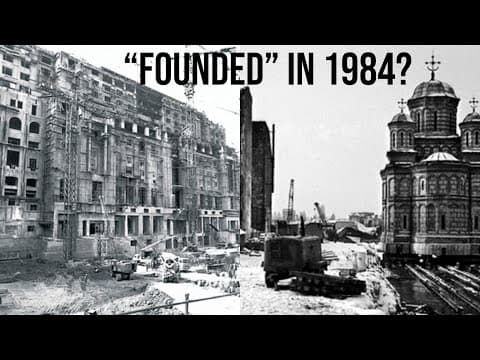
One of the most intriguing aspects of the Palace of Parliament is the lack of construction photographs. While the building is a significant architectural feat, the few images that exist primarily depict excavation rather than construction. This absence raises questions about the narrative surrounding its creation.
Anka Patrusu, a young architect with no prior experience in building design, was appointed to lead the project. At just 28 years old, she won a contest to design the Palace, despite having only a degree in architecture obtained in 1973. Her rapid ascent in the architectural world, coupled with her involvement in the demolition of old Bucharest, adds layers of complexity to the narrative.
The Palace of Parliament was constructed on Uranus Hill, a site with a rich history dating back centuries. This hill was home to various structures, including a fortified church and a princely court, before being largely demolished to make way for the palace. The construction was reportedly made possible by the devastating earthquake of 1977, which destroyed much of the old city of Bucharest.
The construction of the Palace involved upwards of 100,000 workers, many of whom were prisoners and untrained soldiers. This fact raises concerns about the quality of labor and the conditions under which the palace was built. Official reports claim that only 27 workers died during construction, while firsthand accounts suggest that the number may have been closer to 1,000.
After the fall of the Communist regime in Romania, the new government chose to continue the construction of the Palace, despite its enormous cost. This decision has led to speculation about the underlying motives behind the palace's creation, including theories about its potential use as a government bunker or other undisclosed purposes.
The Palace of Parliament is not only impressive above ground but also features an extensive underground network. It is said to have at least eight known underground levels, with over 12 miles of tunnels leading out of Bucharest. This hidden infrastructure adds to the intrigue surrounding the building and its intended functions.
A significant factor contributing to the lack of construction photographs is a legal battle initiated by Anka Patrusu after the palace's completion. She claimed ownership of the building's image, asserting that the Romanian government could not use photographs of the Palace without her consent. This lawsuit has effectively restricted access to visual documentation of the construction process.
The Palace of Parliament in Bucharest is a remarkable architectural achievement, yet its history is fraught with unanswered questions and contradictions. The absence of construction photographs, the controversial narrative surrounding its creation, and the legal complexities involving its architect all contribute to a sense of mystery. As we reflect on this monumental structure, it prompts us to question the narratives we accept about history and the forces that shape our understanding of the past.