The Shanghai World Financial Center, designed by William Pettison, faced significant challenges during its construction, including cultural sensitivities and economic shifts. Initially designed with a circular opening, public backlash led to a redesign into a square shape, symbolizing the complex relationship between architecture, identity, and modern China's rapid urbanization.
The story of the Shanghai World Financial Center is not just about a building; it encapsulates the essence of modern China, its rapid urbanization, and the symbolic power of architecture. This skyscraper, which stands as a testament to China's ambitions, faced a pivotal moment during its design phase when a simple question arose: what is the difference between a circle and a square?
In the early 1990s, China was undergoing a transformation. Following the economic turmoil of Black Monday in 1987, while the United States faced a recession, China was booming. The country was opening up to international markets, leading to the largest migration in human history, with approximately 300 million people moving to urban areas. Shanghai was poised to become the financial hub of China, necessitating the construction of numerous skyscrapers to accommodate this rapid growth.
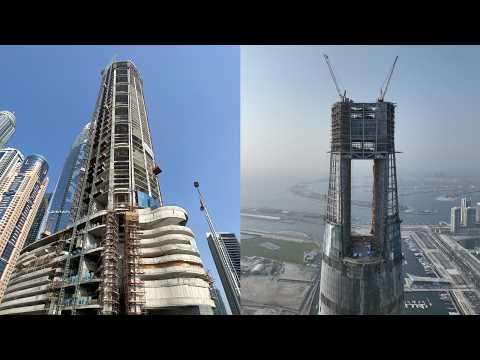
William Pettison, an American architect, was tasked with designing one of these skyscrapers. He envisioned a structure that would connect the earth and the sky, symbolizing the aspirations of a modernizing China. His design featured a circular opening at the top, representing the heavens, juxtaposed with a square base symbolizing the earth. This design was not only aesthetically pleasing but also functional, as the void would help stabilize the building against strong winds.
After submitting the plans in 1993, Pettison faced a unique review process. Fourteen architecture professors were given limited time to critique the design, resulting in a mix of opinions. Despite some reservations, the building was approved, and construction began in 1995. However, the Asian financial crisis of 1997 halted progress, leading to a hiatus that lasted until the early 2000s.
The resumption of construction in 2001 came in the wake of the September 11 attacks, which changed global perceptions of skyscrapers. New safety regulations were introduced, and the building's height was increased by 32 meters. However, this posed a challenge as the existing foundations were not designed to support the additional weight. Structural engineer Les Robertson devised a solution that allowed for a lighter design, incorporating diagonal braced frames and outrigger trusses.
As construction progressed, public sentiment shifted dramatically. The circular void in the design began to be perceived as resembling a Japanese flag, which sparked outrage among the Chinese populace, given the historical context of Japanese occupation during World War II. In response to this backlash, Pettison attempted to modify the design by adding a bridge to disrupt the circle, but this was insufficient to quell public discontent.
Ultimately, the design was altered in 2005, transforming the circular opening into a square. This change was not only a response to public sentiment but also had practical implications for the building's functionality and economic viability. The Shanghai World Financial Center was completed in 2008, becoming a prominent feature of the Shanghai skyline, although it did not claim the title of the tallest building in the world.
Today, the Shanghai World Financial Center stands as an iconic structure, often referred to as the "bottle opener" due to its distinctive shape. It symbolizes the rapid growth and modernization of Shanghai and China as a whole. The building has been embraced by the public, reflecting a complex relationship between architecture, identity, and cultural history.
The journey of the Shanghai World Financial Center illustrates the intricate interplay between design, cultural identity, and economic forces in modern China. As the country continues to evolve, this skyscraper remains a testament to the aspirations and challenges faced during a pivotal moment in its history. The legacy of this building is not just in its height but in its ability to connect the past with the future, embodying the spirit of a nation in transformation.