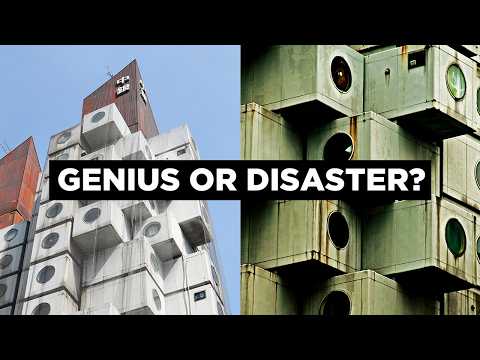
The Nakagin Capsule Tower, a revolutionary modular building in Tokyo, aimed to redefine urban living through mass production and adaptability. Despite its eventual failure to renew itself, its innovative concepts have influenced modern construction practices, highlighting the ongoing relevance of Kisho Kurokawa's vision.
The Nakagin Capsule Tower, a striking example of 1970s architecture, stands as a testament to Japan's ambitious vision for urban living. This modular apartment building, located in downtown Tokyo, was designed to be a living organism, capable of evolving with the needs of its residents. However, despite its innovative design, the tower ultimately failed to achieve its intended purpose. This blog post explores the history, design, and legacy of the Nakagin Capsule Tower, shedding light on its impact on modern construction.
In the 1960s, Japan was experiencing a remarkable economic boom, having rapidly rebuilt after World War II. Tokyo's population surged from 11 million to 23 million in just two decades, leading to unprecedented urban growth. Urban planners sought radical solutions to accommodate this influx, proposing ideas like floating cities and sky-high structures. Amidst this backdrop, architect Kisho Kurokawa conceived the Nakagin Capsule Tower, a project that embodied the principles of the Metabolism architectural movement.
Metabolism, a term coined by Kurokawa and his contemporaries, emphasized the need for buildings to adapt and evolve over time. The Nakagin Capsule Tower was designed with this philosophy in mind, featuring 140 modular capsules that could be replaced or upgraded as needed. This approach aimed to create a dynamic living environment that could respond to changing urban demands.
The Nakagin Capsule Tower was constructed using a steel frame and reinforced concrete, with a two-story base housing utilities and a café. The capsules, measuring four meters in length and two and a half meters in width and height, were manufactured offsite and designed for easy installation. Each capsule was equipped with basic amenities, reflecting the lifestyle of the salarymen it catered to, while also drawing inspiration from yacht interiors to maximize space.
Kurokawa's design utilized mass production techniques to streamline construction. Elevator shafts and utility racks were prefabricated, allowing for rapid assembly on-site. Despite the challenges posed by the tower's location in Tokyo's busy Ginza district, construction was completed in just 14 months, with each capsule taking only three hours to install.
Upon its completion in 1972, the Nakagin Capsule Tower symbolized Tokyo's forward-thinking spirit. However, the economic bubble burst in the early 1990s, leading to stagnation and a decline in the tower's condition. Despite its original intent, not a single capsule was ever replaced due to design flaws and the lack of a sustainable production line for new capsules.
The tightly packed design meant that removing one capsule required the removal of several others, making upgrades impractical. Additionally, the reliance on mass consumption for the tower's success was undermined by changing economic conditions. By 2007, rising land values and the building's deteriorating state prompted residents to vote for redevelopment, leading to the tower's demolition in 2022.
While the Nakagin Capsule Tower may have been a physical failure, its ideas continue to resonate in contemporary architecture. The concepts of modular construction and adaptability have found new life in various projects worldwide, from housing schemes in Hong Kong to shipping container developments in urban areas.
Today, the construction industry is increasingly embracing component-based design, breaking buildings down into easily produced elements. This shift reflects Kurokawa's vision of architecture that adapts to changing needs, albeit in a different context than he envisioned.
The Nakagin Capsule Tower remains a significant chapter in architectural history. Although it did not fulfill its promise of renewal and adaptability, its legacy lives on in the growing trend of modular construction. Kisho Kurokawa's belief that architecture should evolve with society was ahead of its time, and as the world catches up, the ideas behind the Capsule Tower continue to inspire innovation in urban living.