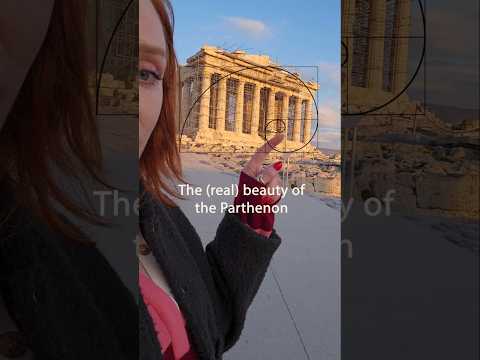
The Parthenon, often associated with the golden ratio, reveals a more complex mathematical design. Contrary to popular belief, it features no straight lines, with a curved base and uniquely angled columns, showcasing the ancient Greeks' advanced architectural understanding.
The Parthenon, an iconic symbol of ancient Greece, is frequently celebrated for its architectural beauty and supposed adherence to the golden ratio. However, a closer examination reveals a more intricate design that challenges common perceptions about this ancient structure.
Many enthusiasts claim that the Parthenon exemplifies the golden ratio, a mathematical ratio often associated with aesthetics and beauty in art and architecture. This ratio is defined as the division of a line into two parts such that the ratio of the whole line to the longer part is the same as the ratio of the longer part to the shorter part. Despite these claims, there is no written evidence that the ancient Greeks intentionally used the golden ratio in the design of the Parthenon. Furthermore, measurements of the structure do not consistently conform to golden ratio values.
What is truly fascinating about the Parthenon is not its supposed adherence to the golden ratio, but rather its unique architectural features that create an illusion of perfection. From a distance, the Parthenon appears to have straight lines and perfect symmetry. However, upon closer inspection, one discovers that there are no straight lines in the entire structure.
The Parthenon is built on a base that curves away from the center in both directions. This subtle curvature is a deliberate design choice made by the architects to counteract the optical illusion that straight lines can appear to bend when viewed from a distance. Additionally, the columns of the Parthenon do not point directly upwards; instead, they are angled inward toward the center of the building. This design technique was employed to ensure that the structure would appear straight and symmetrical when viewed from afar.
When the architectural community first recognized these design elements in the 1800s, many were skeptical. The precision and cleverness of the design were deemed too advanced for the technology available to the ancient Greeks at the time. Some theorists even suggested that earthquakes might have caused the curvature observed in the structure. However, it is now understood that the Greeks intentionally designed the Parthenon with these features, showcasing their advanced understanding of geometry and optics.
One of the most remarkable aspects of the Parthenon is that every segment of its columns is unique. This level of precision indicates that the architects possessed a sophisticated understanding of architectural principles, allowing them to create a structure that not only stood the test of time but also captivated the human eye.
In conclusion, while the Parthenon is often mistakenly associated with the golden ratio, its true beauty lies in its complex design and the innovative techniques employed by its architects. The deliberate curvature of its base and the unique angles of its columns demonstrate a level of sophistication that challenges our understanding of ancient Greek architecture. Rather than simply attributing its beauty to mathematical ratios, we should appreciate the Parthenon as a testament to the ingenuity and skill of its creators, who understood the principles of perception and aesthetics far better than we might have assumed.