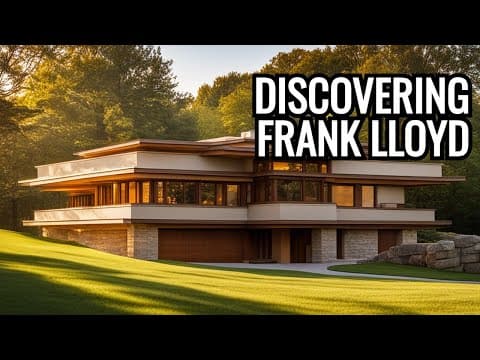
Frank Lloyd Wright remains one of the most influential architects in history, renowned for his innovative designs and profound impact on modern architecture. This article takes you on an informative journey through 112 iconic homes designed by Wright between 1885 and 1916, culminating in the celebrated Prairie House era. We will explore the chronological evolution of his work, highlighting key projects and their significance.
Early Years and Influences (1885-1889)
Wright's earliest works were completed under the firm of Louis Sullivan, a period we will not focus on here. Instead, our exploration begins with Wright's distinctive projects that showcase his unique style and innovative approach to design.
Key Architectural Works by Year
1889-1890
- Frank Lloyd Wright House, Oak Park, Illinois (1889): Wright's own home, marking the beginning of his independent architectural journey.
- Louis Sullivan Summer Cottage, Ocean Springs, Mississippi (1890)
1891
- James Charnley House, Chicago, Illinois
- James Charnley Summer Cottage, Ocean Springs, Mississippi
- W. S. MacHarg House, Chicago, Illinois (Demolished 1926)
1892
- George Blossom House, Chicago, Illinois
- W. Irving Clark House, La Grange, Illinois
- Robert Emond House, La Grange, Illinois
- Thomas Gale House, Oak Park, Illinois
- Dr. Allison Harlan House, Chicago, Illinois (Destroyed by fire in 1963)
- Warren McArthur House, Chicago, Illinois
- Robert Parker House, Oak Park, Illinois
- Albert Sullivan House, Chicago, Illinois (Demolished)
1893-1894
- Walter Gale House, Oak Park, Illinois (1893)
- Francis Woolley House, Oak Park, Illinois (1893)
- Frederick Bagley House, Hinsdale, Illinois (1894)
- Dr. H. W. Bassett Remodeling of House, Oak Park, Illinois (1894) (Demolished 1922)
- Peter Goan House, La Grange, Illinois (1894)
- Four Houses for Robert Roloson, Chicago, Illinois (1894)
1895-1896
- Nathan G. Moore House, Oak Park, Illinois (1895) (Partially demolished and rebuilt in 1922)
- Chauncey Williams House, River Forest, Illinois (1895)
- Alterations to Harrison P. Young House, Oak Park, Illinois (1895)
- H. C. Goodrich House, Oak Park, Illinois (1896)
- Isidore Heller House, Chicago, Illinois (1896)
1897-1899
- George Furbeck House, Oak Park, Illinois (1897)
- Rollin Furbeck House, Oak Park, Illinois (1898)
- River Forest Golf Club, River Forest, Illinois (1898) (Demolished 1905)
- George Smith House, Oak Park, Illinois (1898)
- Joseph Huser House, Chicago, Illinois (1899) (Demolished 1926)
1900-1902
- Harley Bardley House, Kankakee, Illinois (1900)
- Stephen A. Foster Summer Cottage, Chicago, Illinois (1900)
- Warren Hickox House, Kankakee, Illinois (1900)
- Fred B. Jones Summer House, Gate Lodge, Barn, and Stable, Lake Delavan, Wisconsin (1900)
- Fred B. Jones Boat House, Lake Delavan, Wisconsin (1900) (Demolished 1988)
- Henry Wallis Summer Cottage, Lake Delavan, Wisconsin (1900)
- E. Arthur Davenport House, River Forest, Illinois (1901)
- William Frick House, Oak Park, Illinois (1901)
- Susan Lawrence Dana House, Springfield, Illinois (1902)
- Walter Gert Summer Cottage, Whitehall, Michigan (1902) (Mostly demolished)
- Arthur Heurtley House, Oak Park, Illinois (1902)
1903-1905
- George Barton House, Buffalo, New York (1903)
- Edwin H. Cheney House, Oak Park, Illinois (1903)
- William R. Heath House, Buffalo, New York (1903)
- Robert Lamp House, Madison, Wisconsin (1903)
- Francis W. Little House, Peoria, Illinois (1903)
- Mary M. W. Adams House, Highland Park, Illinois (1905)
- Charles A. Brown House, Evanston, Illinois (1905)
- W. A. Glasner House, Glencoe, Illinois (1905)
- Thomas P. Hardy House, Racine, Wisconsin (1905)
- Arthur P. Johnson House, Lake Delavan, Wisconsin (1905)
- Darwi D. Martin Gardener's Cottage, Buffalo, New York (1905)
1906-1908
- Peter A. Beachy House, Oak Park, Illinois (1906)
- K. C. De Rhodes House, South Bend, Indiana (1906)
- Mrs. A. W. Gridley House, Geneva, Illinois (1906)
- Taliesin, Spring Green, Wisconsin (1907)
- Andrew W. Porter House, Hillside, Wisconsin (1907)
- Edward E. Boynton House, Rochester, New York (1908)
- Walter V. Davidson House, Buffalo, New York (1908)
- R. W. Evans House, Chicago, Illinois (1908)
- E. A. Gilmore House, Madison, Wisconsin (1908)
1909-1912
- Frank J. Baker House, Wilmette, Illinois (1909)
- Hiram Baldwin House, Kenilworth, Illinois (1909)
- Dr. W. H. Copeland House and Garage Alterations, Oak Park, Illinois (1909)
- Mrs. Thomas Gale House, Oak Park, Illinois (1909)
- J. Kibben Ingles House, River Forest, Illinois (1909)
- Edward P. Irving House, Decatur, Illinois (1909)
- Ingwald Moe House, Gary, Indiana (1909)
- Frederick Robie House, Chicago, Illinois (1909)
- Reverend Jessie R. Ziegler House, Frankfurt, Kentucky (1910)
- O. B. Balch House, Oak Park, Illinois (1911)
- Taliesin, Spring Green, Wisconsin (1911)
- Harry Adams House, Oak Park, Illinois (1912)
- Mrs. Avery Cooley Playhouse, Riverside, Illinois (1912)
- William B. Greene House, Aurora, Illinois (1912)
1915-1916
- Emil Bach House, Chicago, Illinois (1915)
- Sherman M. Booth House, Glencoe, Illinois (1915)
- Joseph J. Bagley Summerhouse, Grand Beach, Michigan (1916)
- Frederick C. Bogk House, Milwaukee, Wisconsin (1916)
- W. S. Carr Summerhouse, Grand Beach, Michigan (1916)
The Legacy of Frank Lloyd Wright's Prairie Houses
The culmination of Wright's work during this period is epitomized by the Prairie Houses, which embody his philosophy of harmony between architecture and nature. These homes feature horizontal lines, flat or hipped roofs with broad overhanging eaves, windows grouped in horizontal bands, integration with the landscape, solid construction, craftsmanship, and discipline in the use of ornament.
Conclusion
Exploring the 112 remarkable homes designed by Frank Lloyd Wright from 1885 to 1916 reveals the sheer brilliance and innovation embedded in each structure. These homes stand as testaments to Wright's unwavering commitment to pushing the boundaries of design and challenging conventional norms. From early experiments to the Prairie House crescendo, each dwelling tells a unique story of harmony, nature, and a profound understanding of the human spirit.
The legacy of Frank Lloyd Wright continues to inspire architects, dreamers, and lovers of beauty worldwide, reminding us of the enduring power of visionary design.