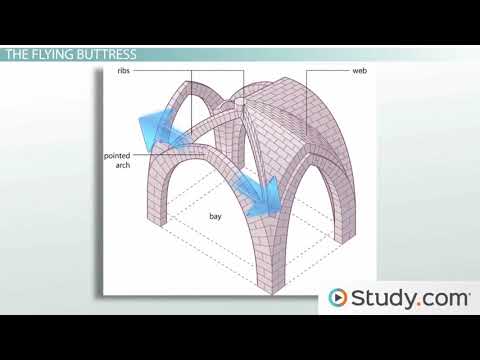
Gothic architecture, emerging in the 12th century, marked a significant departure from Romanesque styles through innovations like the pointed arch, ribbed vault, and flying buttress. These elements allowed for taller, lighter structures filled with stained glass, representing a new era of architectural achievement in medieval Europe.
Gothic architecture emerged in the 12th century, fundamentally transforming the landscape of European church design. This architectural style was pioneered by Abbot Suger during the reconstruction of the Abbey Church of Saint-Denis in 1137. Suger sought to create a church that was not only a place of worship but also a representation of geometric harmony, aspiring towards the heavens and filled with light. The result was a departure from the dark, bulky Romanesque style that preceded it.
Abbot Suger's vision for the Abbey Church of Saint-Denis was realized in a structure that was tall, elegant, and bright, contrasting sharply with the short and imposing Romanesque churches. While Suger's new style was termed "modern," critics labeled it as "gothic," a term that originally referred to the Goths, a group of Germanic tribes known for their invasions of the Western Roman Empire. This label was intended to convey a sense of barbarism and lack of refinement, but it was a mischaracterization of the Gothic style, which represented the pinnacle of medieval architectural achievement.
Gothic architecture is defined by three primary elements:
The pointed arch is a revolutionary feature that distinguishes Gothic architecture from its Romanesque predecessors. The semicircular Roman arch had significant limitations due to its horizontal stress lines, which required thick walls to support the weight above. In contrast, the pointed arch directs stress lines vertically, allowing for taller structures with thinner walls. This innovation enabled architects to create buildings that were not only higher but also filled with light, as the walls could accommodate larger windows.
The ribbed vault is another critical advancement in Gothic architecture. It is essentially an extended arch made of masonry that roofs a building. Early vaulted churches utilized the semicircular arch, resulting in heavy barrel vaults that pushed outward against the walls. Romanesque architects developed groin vaulting to redirect weight to specific points, but Gothic architects took this further with ribbed vaulting. This technique involves a framework of strong ribs that support lighter materials, allowing for a more efficient distribution of weight and reducing the need for massive walls.
To address the outward pressure exerted by the vaulted ceilings, Gothic architects introduced the flying buttress. This external support system redirects the horizontal forces from the vaults down into the ground, allowing for the construction of soaring cathedrals. The flying buttress not only provided structural support but also maintained the aesthetic quality of the buildings, as it did not obstruct the large stained-glass windows that became a hallmark of Gothic cathedrals.
As Gothic architecture developed, particularly in England, rib vaulting became even more intricate, leading to a distinct English style known as fan vaulting. This evolution showcased the adaptability and creativity of Gothic architects as they refined their techniques and designs.
Gothic architecture represents a significant milestone in the history of building design, characterized by its innovative use of the pointed arch, ribbed vault, and flying buttress. These elements not only allowed for the creation of magnificent cathedrals that reached new heights but also transformed the way light entered these sacred spaces, creating an atmosphere of inspiration and reverence. The Gothic style marked a departure from the constraints of Romanesque architecture, paving the way for a new era of architectural achievement in medieval Europe.