New York's skyscrapers reflect the city's history, ambition, and challenges. From the Chrysler Building to the modern towers of Billionaires' Row, each structure tells a story of its time, embodying the spirit of New York and its ever-evolving identity.
It’s said that you can tell a lot about a city by its tallest building. In New York, that was once the Chrysler Building, a symbol of capitalism colliding with art and hubris. Over the years, the city’s tallest building has changed hands many times, but the Chrysler has become a landmark in a place synonymous with the skyscraper. Today, it faces the prospect of being overshadowed by a new generation of glass-covered office towers.
Manhattan’s identity is deeply intertwined with its skyscrapers. When the island was first formed millions of years ago, its geographic size was not notable. Had it remained a small low-rise island, it likely wouldn’t have developed into the bustling metropolis it is today. Skyscrapers have allowed New York to continuously expand, welcoming millions of people and businesses eager to be part of its vibrant landscape.
These awe-inspiring structures have risen through every chapter of the city’s story, each reflecting the context and forces at play during its time. From the extravagance of the 1920s to the slick modernism of the 1960s, skyscrapers have personified the excess of the 1980s and faced an existential crisis after 9/11. In the 2020s, they again represent some of the city’s biggest challenges.
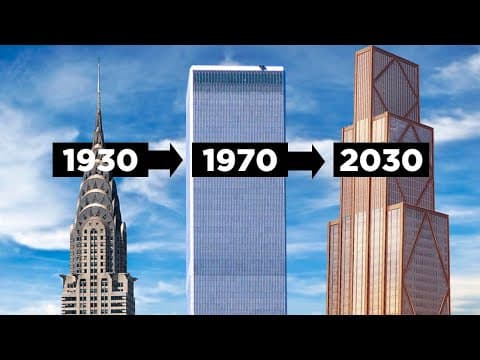
Joseph Campbell famously stated that you can tell a lot about a city by its tallest building. In medieval times, it was often the spire of a cathedral; in the 18th century, it was the political palace. In 1920s New York, it was the office building, embodying the American dream through steel and sheer grit. The Chrysler Building, completed in 1930, was a shining beacon of the city’s arrival as the world’s metropolis, marking the transition of power from London to New York.
The Chrysler Building’s existence was fueled by the fierce rivalry between architects Craig Severance and William Van Alen. Severance was tasked with designing the Manhattan Co. Building, while Van Alen was commissioned for the Chrysler Building. Both aimed to create the world’s tallest skyscraper, leading to a dramatic competition that involved stealing or leaking plans. Ultimately, Van Alen’s secret spire allowed the Chrysler Building to surpass its rival by 36 meters, securing its title as the tallest building in the world for a brief period.
Despite initial criticism, the Chrysler Building is now celebrated as one of the greatest examples of Art Deco architecture, symbolizing the opulence and ambition of its time.
Walter Chrysler envisioned his skyscraper as a representation of luxury, but the onset of the Great Depression soon overshadowed this ambition. The building, which had only held the title of the world’s tallest for eleven months, was quickly surpassed by the Empire State Building. The economic downturn led to a 40-year hiatus in record-breaking skyscrapers, as the city’s focus shifted elsewhere.
By the 1960s, New York was a city in turmoil, marked by protests and violence. The architectural response was a shift towards simplicity and function. Japanese-American architect Minoru Yamasaki designed the World Trade Center, featuring two enormous twin towers that represented a new era of modernism. These towers, completed in 1973, became iconic symbols of New York, despite initial public skepticism.
The 1980s brought a new wave of skyscrapers that embodied the era's risk and excess. Trump Tower, completed in 1983, became a symbol of luxury and ambition, showcasing the architectural style of the time. However, its construction was not without controversy, as it involved the demolition of the historic Bonwit Teller Store and faced criticism for its opulence amidst rising crime rates in the city.
The events of September 11, 2001, profoundly impacted New York and its skyscrapers. The city faced an identity crisis, questioning the future of tall buildings. Many architects and developers hesitated to create new skyscrapers, fearing they would become targets for terrorism. However, the Hearst Tower emerged as a symbol of resilience, being the first prominent skyscraper completed after 9/11.
As the 2000s progressed, New York began to rebuild, with the new World Trade Center rising from the ashes of the old. This new tower, reaching a symbolic height of 1,776 feet, serves as a reminder of resilience and hope. The city’s skyline began to evolve again, with developers pushing the limits of engineering to create innovative structures.
In the 2020s, New York has witnessed the emergence of Billionaires’ Row, where extreme wealth drives the construction of ultra-luxury skyscrapers. Developers have acquired air rights to build taller structures, leading to the creation of the world’s thinnest skyscraper, 111W57. These buildings represent a new chapter in New York’s history, where architecture is viewed as an asset rather than just property.
Looking ahead, New York is on the brink of a new skyscraper boom, with several supertalls set to rise in Midtown East. The rezoning of this area has allowed for greater density, paving the way for innovative designs that reflect the changing needs of the city. Despite challenges posed by the pandemic and economic uncertainties, the skyscraper remains a vital part of New York’s identity.
New York’s skyscrapers are more than just buildings; they are monuments to the city’s history, ambition, and resilience. Each structure tells a story of its time, reflecting the values and priorities of the era. As the skyline continues to evolve, it remains a testament to the ever-changing spirit of New York City, a place that will never be finished, always adapting to the future while honoring its past.